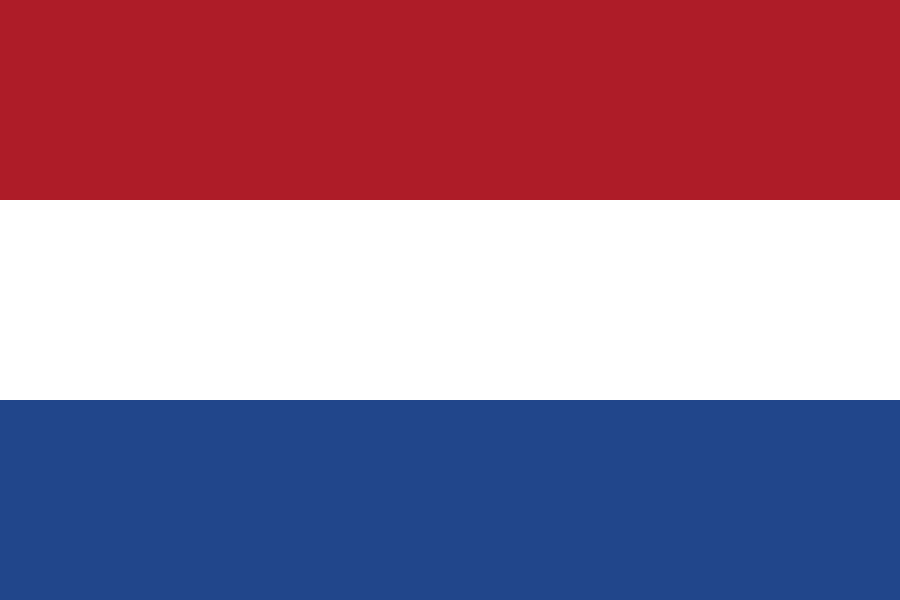
 vs
vs 
Netherlands vs France: which should you study in?
Both are strong destinations, and the honest answer depends on your budget, your grades and whether you want to stay on after graduating. Here is the side-by-side.
Netherlands vs France, line by line
| Metric | Netherlands | France |
|---|---|---|
| Living cost | ≈ $15,500 | ≈ $14,500 |
| Tuition from | ≈ $7,500 | ≈ $450 |
| Average tuition | ≈ $17,900 | ≈ $7,700 |
| Total per year | ≈ $33,400 | ≈ $22,200 |
| Post-study work | 1 years | 1 years |
| Work while studying | 16 h/week | 20 h/week |
| PR pathway | moderate | moderate |
| Institutions | 18 | 15 |
| Courses listed | 78 | 47 |
| World rank | #49 | #24 |
| Typical entry grade | 70% | 75% |
| English requirement | IELTS 6.4 | IELTS 6.5 |
Which one fits you?
Choose Netherlands if…
- ✓you want more institutions to choose from (18 here)
Choose France if…
- ✓you want lower living costs (about $1,000 a year less)
- ✓you want cheaper tuition (from $450 a year)
- ✓you are targeting a higher-ranked university
The short version
France is the cheaper route on total annual cost, while Netherlands gives you longer to work after you graduate. If you are optimising for permanent residency, Netherlands has the stronger pathway.
Netherlands
Residence permit for study (IND norm: €1,130.77/month of funds, 2026). The 'orientation year' gives 12 months to find work; hundreds of English-taught programs.
France
VLS-TS student visa. Master's graduates can take a 1-year (renewable) job-search stay (APS); public tuition is modest even for non-EU students.
Frequently asked questions
Is it cheaper to study in Netherlands or France?
On total annual cost — tuition plus living — France works out cheaper. Tuition in the Netherlands starts around $7,500 a year against $450 in France, and living costs run $$15,500 versus $$14,500 a year.
Which gives better post-study work rights, Netherlands or France?
Netherlands allows 1 year(s) of post-study work and France allows 1. During term, students can work up to 16 hours a week in the Netherlands and 20 hours in France.
Which is easier to get into, Netherlands or France?
Across the courses we list, the typical competitive grade is about 70% in the Netherlands and 75% in France, with English requirements of IELTS 6.4 and 6.5 respectively. Entry difficulty varies far more by institution than by country.
Other comparisons
Estimated figures. Tuition, living costs and entry benchmarks on this page are estimates for guidance and comparison. Always confirm exact figures with the institution before you apply.
Still torn between Netherlands and France?
Put your marks, budget and goals in and we will score real courses in both countries, then tell you which side wins for your profile.
Get my matches →